
How to Plan a Tiger Safari in India from the USA, UK or Europe
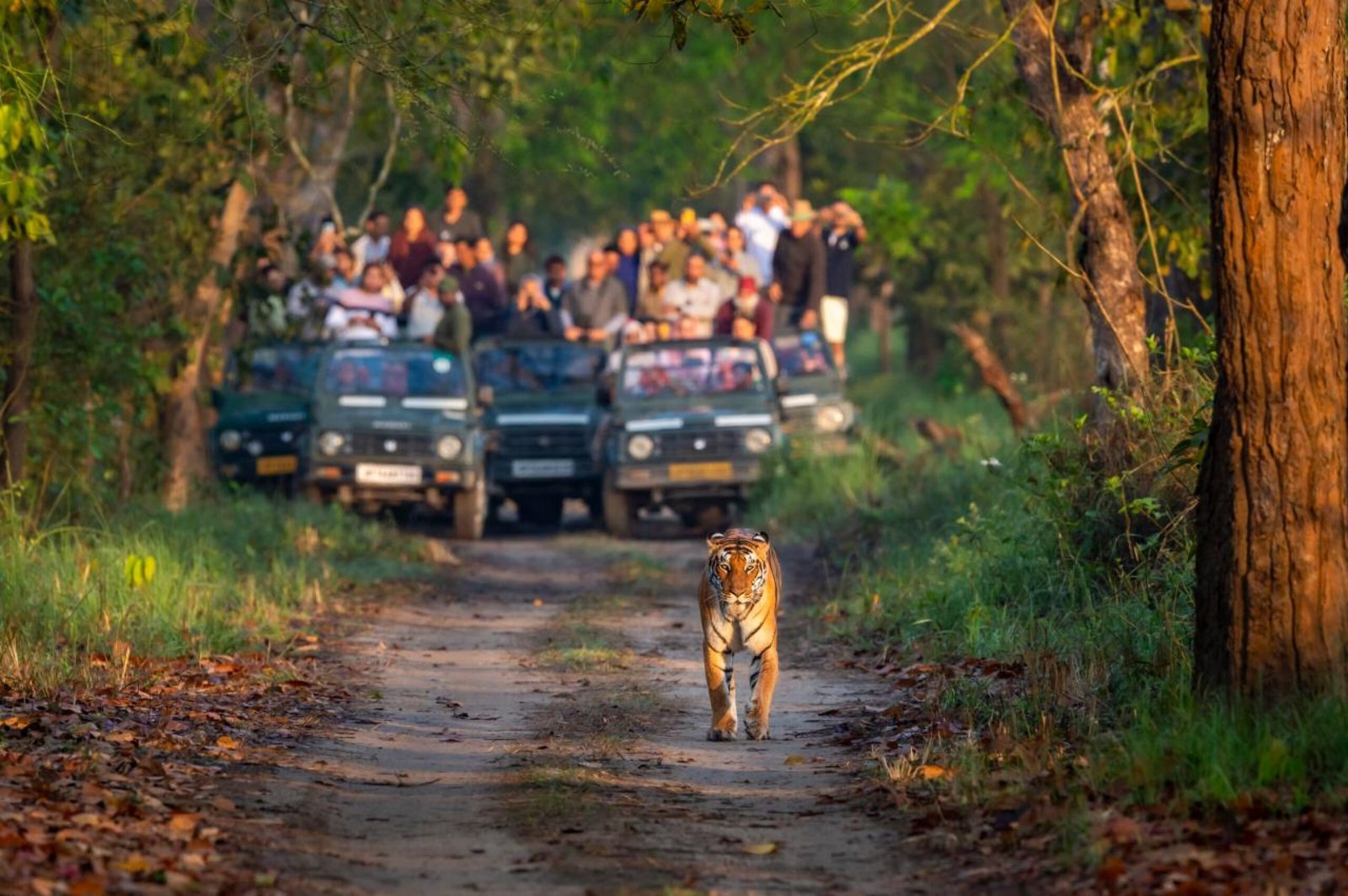
There is a moment on every good tiger safari that nobody puts in the brochure. It’s about forty minutes into a cold morning drive. There is silence at this point. Suddenly a langur is hollering from the branches of a sal tree, a spotted deer cautiously replies, and your guide turns off the engine, points ahead at a spot you can see nothing in.
That’s the experience you’re flying eighteen hours for. Not a guaranteed tiger. The wait, and then, if the forest is generous, the tiger.
The trouble is that planning a tiger safari India from the USA, UK or Europe works nothing like planning a trip to Kenya or Costa Rica. Permits are sold by state forest departments on a fixed calendar, in rupees, months before you fly. Number of vehicles entrying the jungle are capped by law. Parks shut for a quarter of the year due to monsoons. And the airport that you land at is usually four hours of highway drive from your wilderness lodge.
None of that is difficult once you know the sequence, a blueprint on how to plan a tiger safari in India. It is here, in the order that you should do it.
-
Brief Outline
Your 12 month timeline
-
Step by Step Plan
Details explained for planning tiger safari in India
Brief Outline: your 12-month planning horizon
If there is only one section you skim, read this one.
When | What you do |
10–12 months out | Pick your travel month and lock the number of nights. Decide which parks. |
8–10 months out | Book long-haul flights and reserve your lodges. The good lodges fill first, not the permits. |
4–5 months out | Book safari permits the day the window opens. This is the non-negotiable date. |
2–3 months out | Book domestic flights and ground transfers. Sort travel insurance. |
3–6 weeks out | Apply for your e-Visa. |
2 weeks out | Get an eSIM, throw layers, and download offline maps. Get every pickup time in writing. |
The single biggest blunder that most travellers make is doing this list backwards: flights first, lodge second, permits whenever! By then the zone you wanted is gone.
Step by Step Planning Explained
India's tiger reserves are seasonal in a way that catches people out. Core zones close for the monsoon, roughly 1 July to 30 September, and reopen through October. Some reserves open their gates on 1 October, others in mid-October, and the exact date is published by the state forest department each year.
October to November: The forest is still green and thick from the rain, which is beautiful and terrible in equal measure. Beautiful because the light is soft and the grass is high. Terrible because a tiger fifteen metres away can be completely invisible. Temperatures are mild. Crowds are moderate. Good for first timers who want the whole forest experience, not just the cat.
December to February: Cool, dry, comfortable. Mornings genuinely cold: 4–10°C at dawn in central India, and you'll be sitting in an open jeep doing 30 km/h. As the undergrowth thins, the sightings are consistent and on the rise. Optimum for those sensitive to heat, which falls beautifully around Christmas, New Year and February half-term
March to June: Prime time for serious sightings. Water dries up, the forest opens out, and animals concentrate around a handful of waterholes on predictable routes. Vegetation that hid everything in October has dried and fallen by April, and Kanha's open meadows offer clear views across hundreds of metres. The catch is real: 40–45°C by May. Afternoon drives are punishing. Most dedicated wildlife photographers book this window anyway.
There are over fifty tiger reserves in India. You may need two, possibly three, Max five for tiger safari in India.
Note- As per target species more than 5 may also be required but for tiger safari in India 5 is max required.
Here's how the main contenders compare for an international visitor:
Reserve | State | Nearest airport | Best for |
Bandhavgarh | Madhya Pradesh | Jabalpur (~4 hrs) | High tiger density; the classic first-timer choice |
Kanha | Madhya Pradesh | Jabalpur (~3.5 hrs) | Big meadows, barasingha, superb photography |
Pench | Madhya Pradesh | Nagpur (~2 hrs) | Easiest access, teak forest, good for short trips |
Tadoba | Maharashtra | Nagpur (~3 hrs) | Excellent summer sightings, fewer international crowds |
Ranthambore | Rajasthan | Jaipur (~3.5 hrs) | Ruins, lakes, and the easiest add-on to the Golden Triangle |
Satpura | Madhya Pradesh | Bhopal (~4 hrs) | Walking safaris, canoeing, leopards and sloth bears |
Corbett | Uttarakhand | Delhi (~6 hrs drive) | Riverine landscape, elephants, closest to Delhi |
Two guidelines that are going to change your trip more than any other decision that you make:
Three nights per park, minimum. That gives you five or six drives. A tiger sighting is a probability game, and two drives is not a sample size. Travellers who do two nights each at four parks almost always come home having spent their holiday in a car.
Pair parks together in a logically relevant way. The fastest connection in the country are Bandhavgarh and Kanha which are separated by about five-six hours plus they share Jabalpur airport. Or just drive to Pench or Tadoba, well connected off Nagpur. Everyone who wants tigers and Taj Mahal in one trip, that's where Ranthambore slots into the Jaipur-Agra route very nicely.
If you are calling Kanha in Madhya Pradesh for the party, let's just say that you can only call Ranthambore in Rajasthan if you have included a spare travel day to your itinerary. In theory, it's simply one internal flight. In practice, it's a car, a flight, a car and a day of your life gone.
Safari access in India is government-controlled. You cannot drive your own vehicle in (at least not in tiger reserves), you cannot turn up at the gate and buy a ticket in peak season, and a limited number of jeeps enter each zone per shift. Permits must be booked online in advance, and entry isn't allowed without a valid one.
Three things to get your head around:
- Zones are booked, not parks
Each reserve is divided into zones with separate gates. You have one zone, one date, one shift on your permit. At the time of booking, you pick the zone and after that you cannot select another zone. A zone being sold out does not mean the park is. And ignore the internet folklore that buffer zones are second-class. They aren't. Buffer sightings in Bandhavgarh and Tadoba have been outstanding in recent years, and they're generally quieter.
- The booking window is a hard date
This is where international travellers lose out, because the window often opens before they've finished planning. Set a calendar alert. Count back 150 days from your first safari date, convert 11:00 AM IST into your own time zone, and be at a laptop. In peak season the best zones in Bandhavgarh's Tala or Ranthambore's zones 1–5 can go within minutes. Missed it? A premium tatkal quota opens closer to the date, and last-minute inventory exists, but relying on it in December or April is a gamble with your holiday.
- The paperwork is unforgiving
Permits are issued in named individuals' details and are non-transferable and non-refundable once issued. You must carry the same government ID you used when booking, which for you means your passport, and the details must match exactly. Permits are issued in named individuals' details and are non-transferable and non-refundable once issued. You must carry the same government ID you used when booking, which for you means your passport, and the details must match exactly.
A realistic template for a 10-day trip landing from London, Frankfurt or New York:
- Day 1: Arrive Delhi. Sleep. Do nothing ambitious.
- Day 2: Fly Delhi to Jabalpur, transfer and drive to Bandhavgarh (approx. 4 hrs.) Evening at the lodge.
- Days 3–4: Bandhavgarh. Five safari drives.
- Day 5: Drive to Kanha (5–6 hours).
- Days 6–7: Kanha. Five or six drives.
- Day 8: Drive to Pench (3 hours).
- Day 9-10: Pench. Five or six drives.
Day 10: Drive to Jabalpur, fly to Delhi, connect to your international flight.
The majority of USA, UK and EU Travellers apply for an e-Tourist Visa online, at the official government portal indianvisaonline.gov.in. The 30 days or one-year visa covers your entire safari for a single trip. Apply roughly three to six weeks out. Your application will not be processed unless you pay the fee at least four days in advance of your date of arrival.
Direct services run to Delhi and Mumbai from London, Frankfurt, Paris & Amsterdam plus other hubs across the UK & Europe. You fly direct from the USA into Delhi from New York, Newark, Chicago, San Francisco and Washington DC but also Gulf carriers provide more one-stop options, possibly cheaper. Fly into Delhi for central India and Rajasthan. It has the best domestic onward connectivity to Jabalpur, Nagpur and Jaipur.
Apparel: Low key greens, browns, khaki and grey. No vivid colours, no white colour, no camouflage print for safari. Layers are essential from November to February. A fleece plus a windproof jacket for dawn drives, stripped off by 9:00 AM. A buff or scarf for dust.
Sun and Dust: A broad-brimmed hat, very high SPF Sunscreen or barrier cream and sunglasses. The dust in April is a genuine factor for contact lens wearers.
Camera gear: A 100–400mm or 150–600mm zoom covers almost everything. Bring a bean bag rather than a tripod, which is useless in a moving jeep. Pack twice the number of memory cards and batteries than you think you need and get a rocket blower to remove dust from lenses.
Binoculars: Bring your own. Lodge loaners are usually limited and may be scratched due to multiple users.
Documents: A printed permit, passport, photocopy of the photo page of your passport in separate.
This matters more than the star rating on the lodge.
Signs of a good operator:
- They tell you sightings are never guaranteed. Tigers are wild animals with minds of their own, and no sighting can ever be fully guaranteed, and anyone promising otherwise is either lying.
- They book permits in your passport name and confirm same on a email.
- They use naturalists who can identify birds, not just vehicle drivers.
- They tell you the approach and which park and why.
And when you're in the vehicle: don't tip a driver for aggressive driving, don't ask to get closer, and don't stand up when a tiger is on the road. The forest guide has the final say. That is not bureaucracy, it is why we have tigers to see.
Dos and Don’ts
Dos
- Follow your guide's instructions — don't push for closer approaches or route changes
- Wear neutral, comfortable clothing in earthen colors like beige, olive, brown, grey.
- Carry essentials: ID and permit, reusable water bottle, binoculars, sunscreen, repellent, camera with spare batteries, medicines; minimise plastic
- Stay quiet and listen — alarm calls and birdsong signal predator movement
- Keep a respectful distance; give animals room to behave naturally
- Appreciate all wildlife like birds, deer, reptiles, tracks, flora while to wait for the big cats
- Carry all rubbish back out; leave no trace
- Drive slowly within speed limits and stick to the permitted zone routes
Don'ts
- Don't step out of the vehicle and with your guide's approval only at designated spots)
- Don't feed or lure wild animals
- Don't ask the driver to chase, speed, go off-road, or block an animal's path
- Don't use flash photography or make unnecessary camera noise
- Don't smoke or carry alcohol and flammable items into the reserve
- Don't take souvenirs — no flowers, feathers, stones, antlers
Golden rule: never make an animal change its behaviour because you're there.
Enquire your Tiger Safari in India now!
India tiger safari designed to help you witness the loved cat in its natural habitat.
Our suggested tours for best Tiger Safari in India
Sample itineraries to help you plan your tiger safari in India for a holistic wilderness experience.
Taj and Tiger Tour
A tiger safari tour of central India highlands principally with visit to the architectural marvel – Taj Mahal.
- 10 DAYS
- Agra - Bandhavgarh - Kanha
Start From
$3499
Temples & Tiger Tour
A heritage tour of India – temples in Varanasi, Khajuraho, and cultures of Agra and Jaipur with Bandhavgarh wildlife.
- 11 DAYS
- Varanasi - Khajuraho - Bandhavgarh - Agra - Jaipur
Start From
$2499
Luxury Tiger Safari
We bring to you a customised 14-day immersive travel into the untamed wilderness of Tiger reserves.
- 14 DAYS
- Bandhavgarh - Kanha - Pench - Tadoba
Start From
$6299
India Big Five Safari
A unique India wildlife tour with Elephant and Tiger Safari covering Bandhavgarh, Kanha and Kaziranga.
- 12 DAYS
- Bandhavgarh - Kanha - Kaziranga
Start From
$2999
Tiger Tour with Golden Triangle
A tailormade tour to sight Indian big cats at Bandhavgarh, Satpura, Pench & Gir. Majorly tigers, lions and target birds.
- 10 DAYS
- Agra - Ranthambore - Jaipur
Start From
$3499
Tiger Tiger Tour
Offers tiger safari in India at Bandhavgarh, Kanha, Pench & Tadoba. Local guides and ample safari in each park.
- 14 DAYS
- Bandhavgarh - Kanha - Pench - Tadoba
Start From
$3499
Indian Big Cats Tour
A tailormade tour to sight Indian big cats at Bandhavgarh, Satpura, Pench & Gir. Majorly tigers, lions and target birds.
- 15 DAYS
- Bandhavgarh - Satpura - Pench - Gir
Start From
$4875
Ultimate Tiger Tour India
Undoubtedly the most complete tiger safari tour of India covering Ranthambore, Bandhavgarh, Kanha, Pench and Tadoba.
- 18 DAYS
- Ranthambore - Bandhvagarh - Kanha - Pench - Tadoba
Start From
$4499
Frequently asked questions
About planning tiger safari in India
For sightings, April and May. For comfort, December to February. October and November provides the greenest forest but the most challenging viewing conditions.
There's no guaranteed number. Most operators suggest planning four to six or more drives across two to three reserves, which gives you good odds without staking everything on one morning.
Yes. The state portals accept international bookings, though payment gateways occasionally reject foreign cards. Many travellers use a licensed operator to handle permits precisely because of this, and because zones sell out during Indian office hours.
Yes. Each permit covers one zone, one date, one shift.
Yes, though very young children struggle with the hours and the cold. Children under five are generally allowed in the jeep with adults without a separate seat.
Wildlife lodges are among the most controlled environments in Indian tourism, with transfers, meals and drives all arranged. In cities and on transit days, usual sensible precautions apply.
Ten to twelve months for peak season. Six months is workable off-peak. Less than four months and your zone choice narrows sharply.
Read Our Latest Travel Blog & Tips Here
Jungle Safari Etiquette – Dos and Donts
Our team has worked out dos & Donts for tourist...
Kuno Cheetahs Set to Co-exist in Leopard and Hyena Territory
Kuno National Park's cheetahs are slowly being educated on a...
9 Types of Wildlife Safaris Modes in India
All 9 Types of Wildlife Safaris in India and finding...
Stripes Unleashed: Where India’s Safaris Roar Loudest Comparison between top tiger safari parks in India
( All the parks are closed during monsoon, July to September )
| National Park | Location | Area | Tiger Population | Landscapes | Focus Species | Time to visit | Nearest airport |
|---|---|---|---|---|---|---|---|
| Madhya Pradesh | 940 km² | Dense Sal and Bamboo forests with rolling grasslands, offering varied landscapes | Tigers, Leopards, Sloth Bears, Wild Dogs, Swamp Deer, Fox, Jackals, Gaur and over 300 bird species | ||||
| Madhya Pradesh | 1,536 km² | The park is set in a rich Sal forest with ancient caves and ruins that add a historical dimension to the safari. | Tigers, Gaur, Sambhar Deer, Foxes and over 270 bird species. | ||||
| Madhya Pradesh | 758 km² | Dry Deciduous Teak forest it is a mix of dense, open meadows, and riverine habitats, offering an excellent opportunity for wildlife sightings. | Tigers, Leopards, Wild Dogs, Jackals, Gaur, Sloth Bear and over 250 bird species. | ||||
| Madhya Pradesh | 542.67 km² | The Ken River runs through the park, offering stunning landscapes and increased chances of tiger sightings near the riverbanks. | Tigers, Leopards, Sloth bears, Hyenas, Crocodiles, Jungle Cat and a variety of bird species, including the endangered Indian vulture. | ||||
| Madhya Pradesh | 1,427 km² | Its dense forests and rugged terrain make it perfect for those seeking a more off-the-beaten-path experience | Tigers, Leopards, Wild Dogs, Sloth Bears Gaur, Giant Squirrels, Black Bucks, Crocodile and a wide variety of birds including migratory water birds. | ||||
| Maharashtra | 625 km² | Tropical dry deciduous forest with Teak and Bamboo as the major plant species. It is a more open forest offering better visibility and has several lakes. | Tigers, Leopards, Sloth Bears, Foxes, Jungle Cat, Wild Dogs and a variety of birds. |
Enquire your Tiger Safari in India now!
India tiger safari designed to help you witness the loved cat in its natural habitat.